Editorial review: 2026-08-13 · General educational content
Fees, regulations, availability, market data and provider features can change. Verify current details with the relevant provider or regulator. This article is not financial advice.
0DTE Options Explained: Why Same-Day Options Trading Is Exploding in 2026
What Are 0DTE Options?
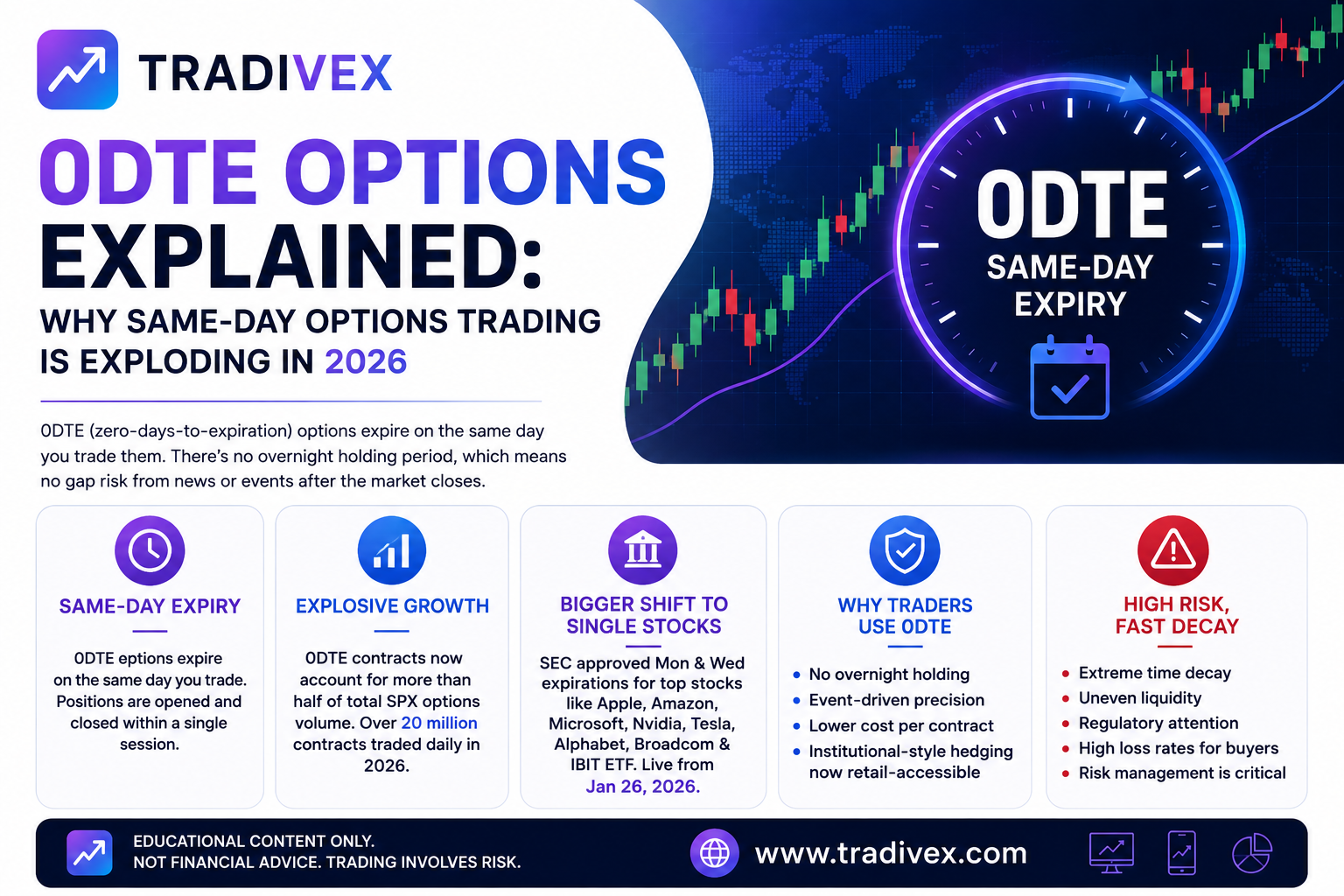
Zero-days-to-expiration (0DTE) options are contracts that expire on the same day they are traded. Because there is no overnight holding period, there is no gap risk from news or events happening after the market closes — the position is opened and closed within a single session.
They aren't a new product category. What's new is how mainstream they've become. Until 2022, S&P 500 index (SPX) options expired only on Mondays, Wednesdays, and Fridays. Once Cboe expanded SPX options to expire every weekday, trading volume in these short-dated contracts surged, and 0DTE contracts now regularly account for more than half of total SPX options volume.
How Big Is 0DTE Trading in 2026?
Cboe's Q2 2026 State of the Options Industry report shows just how far this has gone:
Average daily options volume across the industry reached 72.8 million contracts in Q2 2026, up more than 19% from a year earlier0DTE contract volume specifically was up 46.2% year-to-date, running at more than 20 million contracts a dayRetail investors are estimated to make up roughly 50–60% of SPX 0DTE activity, a share that's now close to institutional participation levels
The Bigger Shift: Daily Expirations Are Coming to Single Stocks
For most of options-market history, individual stocks only had Friday expirations. That changed on January 16, 2026, when the SEC approved a Nasdaq proposal to add Monday and Wednesday expirations for a group of heavily traded single stocks — including Apple, Amazon, Microsoft, Meta, Nvidia, Tesla, Alphabet, and Broadcom, plus the IBIT Bitcoin ETF. These new expirations went live on January 26, 2026.
Previously, only a handful of ETFs — SPY, QQQ, and IWM — had genuinely daily (Monday–Friday) options expirations. Extending same-week and near-daily expirations to individual mega-cap stocks is a meaningful structural change: it brings the fast-moving, intraday dynamics that have defined SPX and QQQ 0DTE trading directly into some of the most widely held stocks in the market.
Why Traders Are Using 0DTE Options
No overnight risk: positions are closed by the end of the day, so there's no exposure to after-hours news or overnight gapsEvent-driven precision: traders can target a specific catalyst — an earnings report, a Fed announcement, an economic data release — without paying for time value they don't needLower absolute cost per contract: because so little time value remains, 0DTE premiums are typically cheaper than longer-dated contracts, which lowers the capital required per tradeInstitutional-style hedging, now retail-accessible: tools that were historically used mainly by institutional desks to manage intraday risk are increasingly available on retail platforms
The Risks Are Real — and Specific to This Product
0DTE options are not simply "cheaper options." Their risk profile is structurally different:
Extreme time decay: value can go to zero within hours, not days. A directionally correct trade can still lose money if the move doesn't happen fast enough.Liquidity is uneven: SPX, QQQ, and SPY 0DTE markets are deep and liquid. The newly added single-stock daily expirations are, so far, thinner — wider spreads and more slippage should be expected until volume builds.Regulatory attention is increasing: Europe's securities regulator, ESMA, has previously flagged concerns about 0DTE-linked exchange-traded products and their potential impact on market stability, and continues to monitor the space.Historically high loss rates for short-dated buyers: data cited by brokers and exchanges consistently shows that a large share of short-dated option buyers lose their full premium. This is a fast, unforgiving instrument, not a beginner-friendly one.
Common 0DTE Approaches
This is educational context, not a trading recommendation — position sizing and risk tolerance are individual decisions.
Credit spreads / iron condors: sell premium around a range, aiming to collect time decay if the underlying stays within a defined band by end of dayDirectional long calls or puts: a lower-cost way to express a short-term view around a specific catalyst, with the tradeoff of very fast time decayIntraday hedging: institutions — and increasingly active retail traders — use 0DTE contracts to offset risk in an existing stock or index position for the remainder of the trading day
Choosing a Platform for 0DTE Trading
Since these are same-day, fast-moving contracts, execution quality matters more than it does for longer-dated positions. Worth checking before trading 0DTE options:
Per-contract fees, since 0DTE strategies often involve multiple legs and higher trade frequencyExecution speed and fill quality, particularly in the newly added single-stock expirations where liquidity is still developingRegulatory status of the broker, verified directly with the relevant regulator (SEC/FINRA in the US, FCA in the UK, etc.)Available underlyings, since not every platform supports the newest Monday/Wednesday single-stock expirations yet
Conclusion
0DTE options have gone from a niche institutional tool to a mainstream, high-volume corner of the options market, and 2026's move toward daily single-stock expirations extends that trend further. The appeal — precision, lower cost per contract, no overnight risk — is genuine. So is the risk: fast time decay, thinner liquidity in newer contracts, and a product structure that has historically produced high loss rates for short-dated buyers. Anyone considering 0DTE options should treat them as a distinct, higher-risk instrument that requires active monitoring, not a cheaper substitute for standard options trading.